Echinus Geyser Reactivated in February 2026
We are wired to look for patterns in the chaos – to make sense of our world. And it seems there’s nothing better that illustrates the chaos theory than the thermal features in Yellowstone. It’s one aspect of these rare natural phenomena that can draw geyser enthusiasts (geyser gazers) back time and again. We try to figure out why a geyser starts and stops activity. Last month, Echinus Geyser at Norris Geyser Basin reactivated. It erupted for 19 days, from February 6 to February 24. At the time of writing, it had surged (a possible attempt at erupting) through March 5. However, no eruptions were observed on the temperature monitor in its overflow channel, indicating that this active phase may have ended.
The last time it was known to erupt was 5 years and 51 days previously in 2020, when it had four eruptions occur over slightly over 26 hours. That happened in December of that year. Prior to that, it was active in 2017 for 39 days in October and November. And even before that, it was very active in 1998. The activity in the 1970s and 1980s was so frequent that the National Park Service built a system of bleachers along the hillside next to the geyser to accommodate crowds waiting for eruptions.
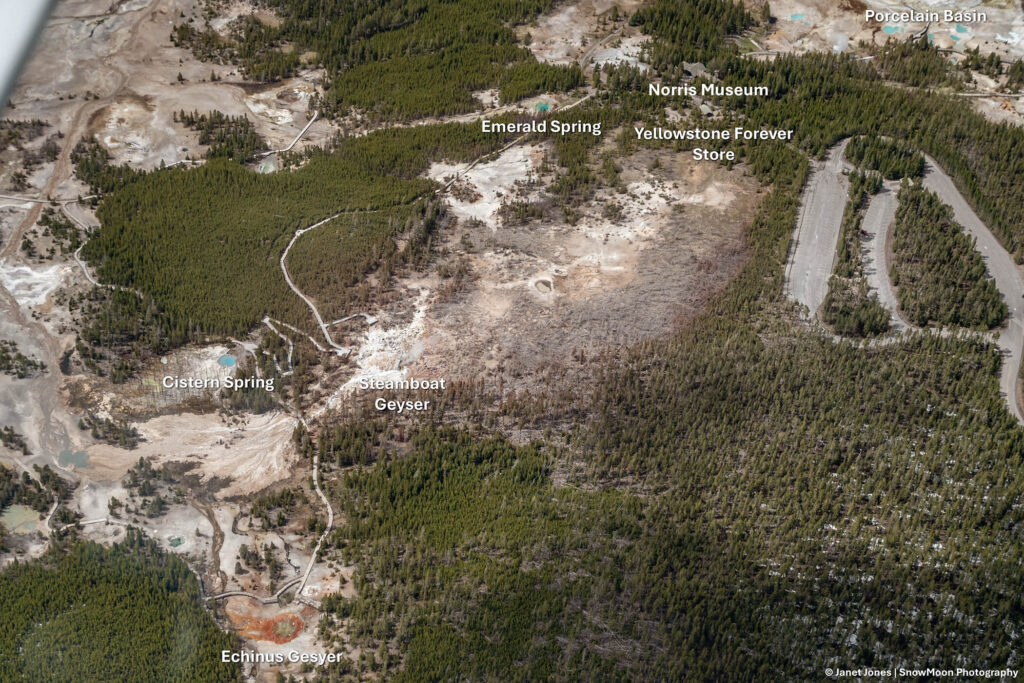
Back Basin Reference
About Echinus Geyser
Location: Echinus Geyser is located in Yellowstone’s Norris Geyser Basin, not very far from Steamboat Geyser.
Name: The name came from the genus for sea urchins. The rhyolite rocks around the geyser have a spiny appearance due to acidic water depositing sinter on them, similar to hard water deposits on a shower head. It was named in 1898 by Albert Charles Peale, who visited on an expedition and thought the rocks looked like sea urchins.
Fun Facts: The rocks lining Echinus’ crater are reddish, due to iron oxide minerals in the water that cling to the rocks as deposits. Also, the water is acidic – in a way similar to orange juice or vinegar. This makes the geyser unusual, as acidic water often breaks down the rocks, preventing a plumbing system supporting eruptions from occurring.
Activity: When active, Echinus Geyser’s pool fills and usually overflows. Next, you’ll notice more bubbling in the pool that increases to boiling. Then surges begin, and the eruption begins. The splashes create lovely waves that circle the eruption. Eruptions generally reach 20-30 feet (6-9 meters) with larger bursts occasionally reported. Bursts can be straight up or angled. If the water reaches the benches, it has cooled to a harmless temperature. The eruptions last 3-5 minutes. When finished, the pool will drain, and the cycle will start again. The time between eruptions, when active, can be 1-3 hours. If activity wanes, the length of time between eruptions will increase.
Electronically Monitored
Echinus Geyser is monitored electronically by the United States Geological Survey (USGS) and publishes the daily and monthly temperature graph online. This comes from a temperature probe placed in the overflow channel in an inconspicuous location. As long as the data logger doesn’t freeze, we generally get this window into the activity at Norris.
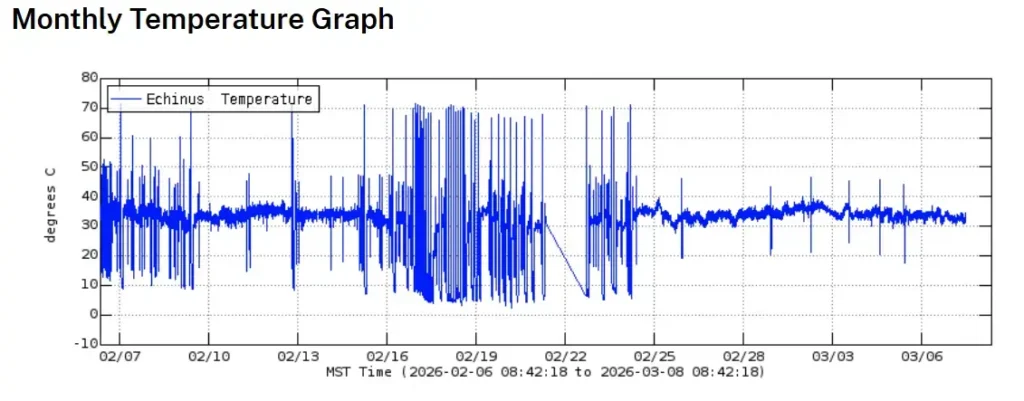
Echinus Temperature Graph
The data retrieved electronically is also entered into GeyserTimes – a citizen science project where many geyser gazers share their observations. Volunteers scan the electronic data and enter the eruptions found.
You can also follow the USGS Volcanoes on Facebook, where Mike Poland, the Scientist in Charge of the Yellowstone Volcano Observatory, shares monthly updates on the activity seen in Yellowstone.
Conclusion
While this active phase for Echinus Geyser might be finished for now, having an opportunity to catch this now rare geyser is always a delight. When active, it’s worth the time waiting for the eruption.
References:
- Issues of GOSA’s Geyser Gazer Sput
- “The Geysers of Yellowstone” by T.S. Bryan (affiliate link)
- “Wonderland Nomenclature: A History of the Place Names of Yellowstone National Park” by Lee Whittlesey
- USGS article about Echinus
- USGS Monitoring Page for Echinus Geyser
- Personal observations of eruptions

Janet Jones
Owner, Publisher, Editor
Janet has a rich history in Cody with her grandparents moving here in the late 1930s. Her grandfather started Wyoming Well Service. Janet is a writer, photographer, graphic designer and webmaster. Cody Journal and Cody Calendar blends her skills and talents with her love of the area.
This article is proudly sponsored by